
Here’s what I found when I took a closer look at one website.
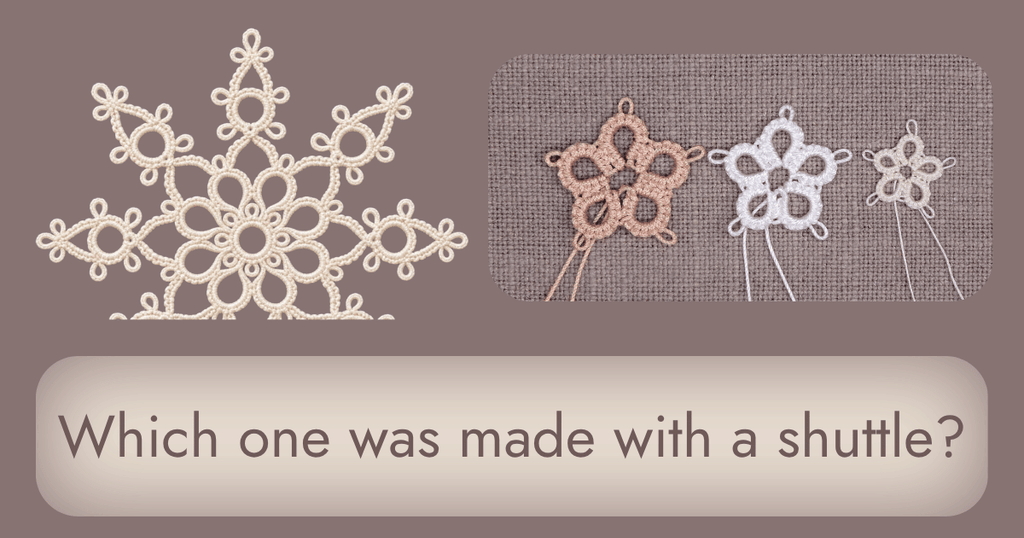
Today Facebook started showing me ads for a bundle of “200+ tatting patterns”. The photos looked lovely. Lace earrings with pearls, doilies on a wooden table, women smiling with shuttles in their hands. All for AUD 64 instead of AUD 135.
I’ve been tatting with a shuttle since 2008. A few seconds of looking at those photos and something didn’t sit right. So I took a closer look at the website, the products, the reviews, and who is actually behind them. I’m writing about it because these ads mostly reach people who are just starting out and don’t yet have a way to judge. If you’re buying tatting patterns online, here’s what I’d check first.
Photos that don’t show real lace
If not all, then almost all of the images on the site and in the ads were generated by AI. To someone who has never tatted, they look convincing. To a tatter, they give themselves away with details you simply can’t make with a shuttle. Some of them are painfully obvious.
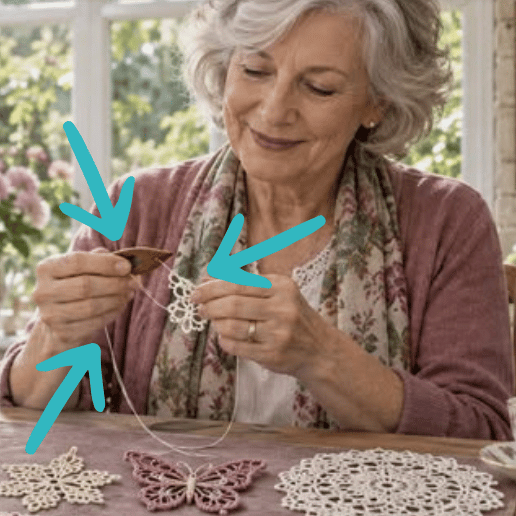
- A shuttle that wouldn’t work. The thread sits loose in an open, hollowed-out shuttle, like a ball of yarn, and comes out of the tip as if it were threaded through it. A real shuttle has two blades that meet at the tips, and the thread is wound between them, around the centre or onto a removable bobbin, and it leaves the shuttle from the middle.
- A chain that isn’t a chain. In the “beginner’s guide”, the chain looks like a row of linked loops, like a crochet chain. A real chain is a row of double stitches worked over the core thread.
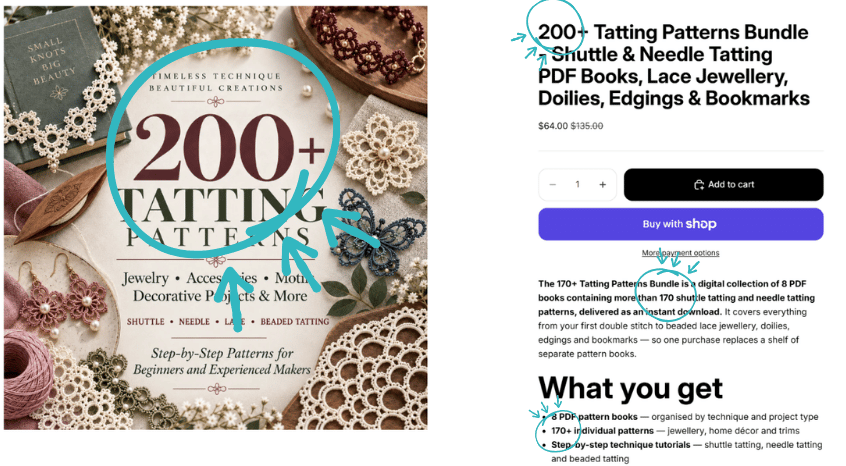
- Tatting with no thread around the hand. The woman on the cover image holds a shuttle and a finished motif, but there’s no thread around her left hand. Without it, you can’t make a single stitch.
- Lace that looks crocheted. Look closely at the rings and picots on the earrings. The stitches look like crochet worked around a ring, and the picots are small closed circles. A real tatted ring is a row of double stitches on a thread that’s pulled closed, and a picot is a loop of thread between stitches.”
- Lace with no trace of work. No thread ends anywhere, and none of the small irregularities every real piece has, even the neatest one.
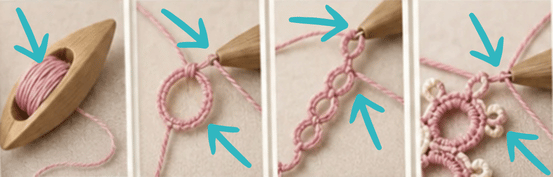
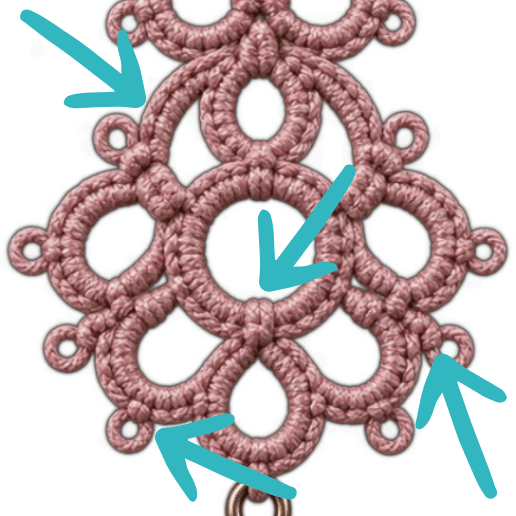
I’m not saying nobody should ever use AI. Quite the opposite. I think it’s an excellent tool. It helps with work and research, and it makes learning easier. The problem starts when an image is there to convince you that you’re buying patterns that will produce lace like this. Here, there’s no way to check, because the site doesn’t have a single photo you could say shows work made from these patterns.
“Reviews” illustrated with AI images
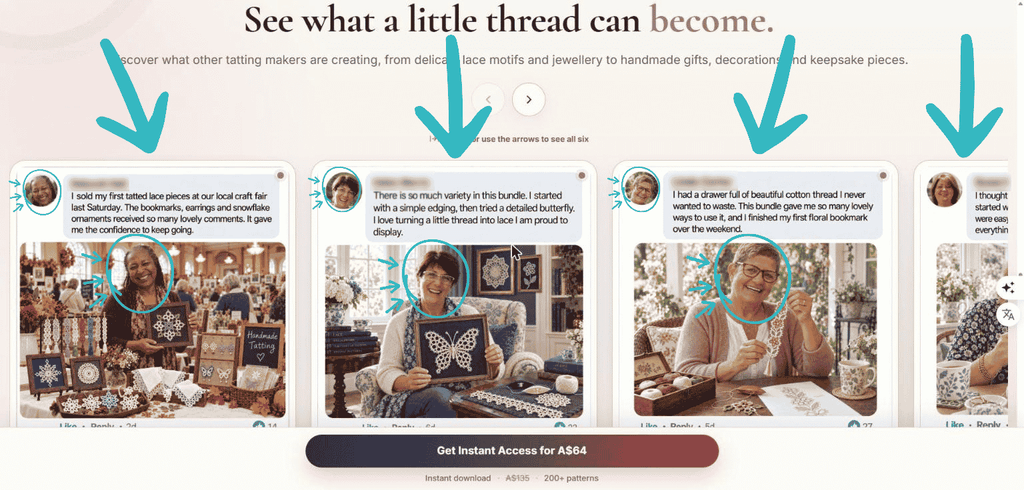
The home page has a section presented as the work of “other tatters”. It’s six posts styled as Facebook comments, with first names and surnames: a woman who sold her first pieces at a craft fair, another proudly showing a framed butterfly, another with a finished bookmark.
Every one of these posts is illustrated with an AI-generated image, in the same style as the rest of the site. On top of that, the profile pictures look as if they were cut out of the very images that illustrate each comment. Same woman, same hair, same clothes. People do sometimes use a photo from a craft fair or with a favourite piece as their profile picture. But not all six people on the site. I don’t know whether the people behind these comments exist. I do know the photos don’t show real women with their own work.
A site that contradicts itself
Read the home page and the product description one after the other:
| On the home page | In the product description |
|---|---|
| 200+ patterns (also in the ads and in the product page heading) | 170+ patterns (in the description on that same product page) |
| Bonus: licence to sell finished pieces | Licence: personal use |
| “No needle” | Patterns for shuttle and needle tatting |
| “Not a single upsell” | Five products in the shop, including combined bundles |
The site showed me prices in Australian dollars, but the product description says the price is £35, converted at checkout. A “50% off” banner sits permanently at the top of every page.
Free books for AUD 47
The shop also sells a “Vintage Tatting Pattern Library” for AUD 47: five classic books, including three Priscilla Tatting Books, DMC Library: Tatting and Anne Orr Tatting Book No. 13. These are old publications you can get free, for example from the Antique Pattern Library. Scans from that library are clearly marked for free distribution only, not for sale.
I can’t say which scans the seller uses. But you don’t need to pay for these books.
Who’s selling this?
There’s no way to tell. The shop’s contact details have no business name, address or phone number, just a Gmail address. The AUD 54 video course doesn’t say who teaches it, how long it is or exactly what it covers. The Facebook page has a few dozen followers.
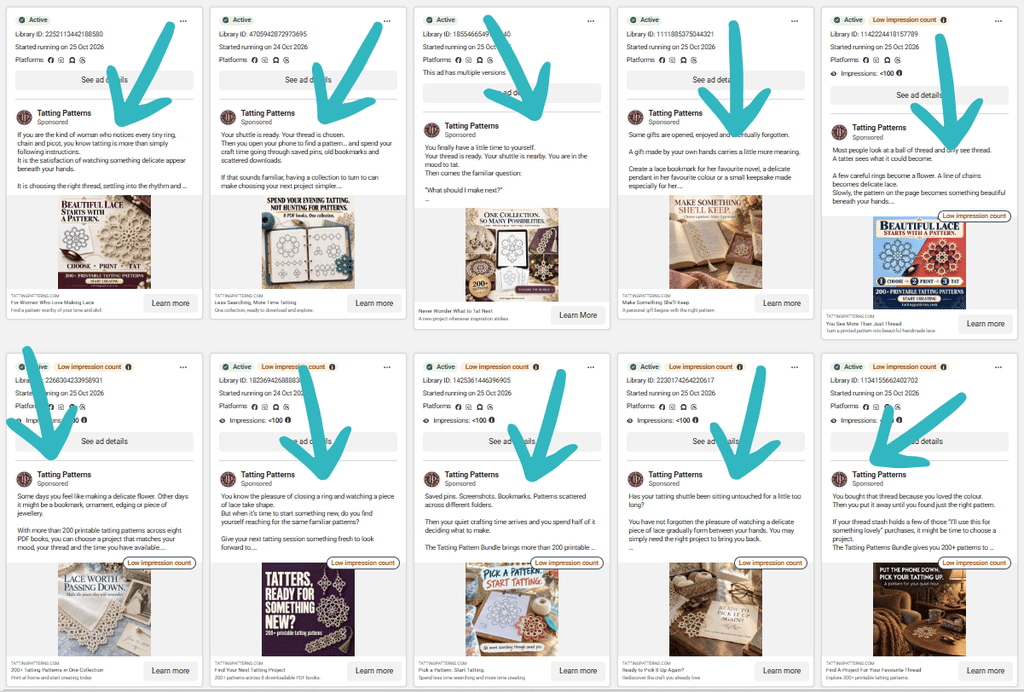
The Meta Ad Library, on the other hand, shows about ten active ads from this page in Australia, all started on 24 and 25 October. That explains the sudden flood in my feed.
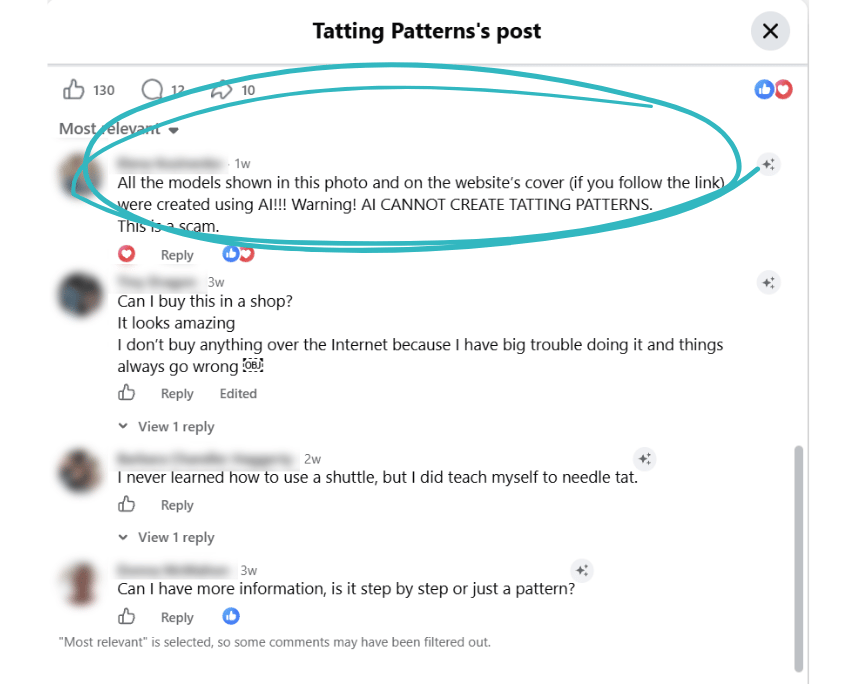
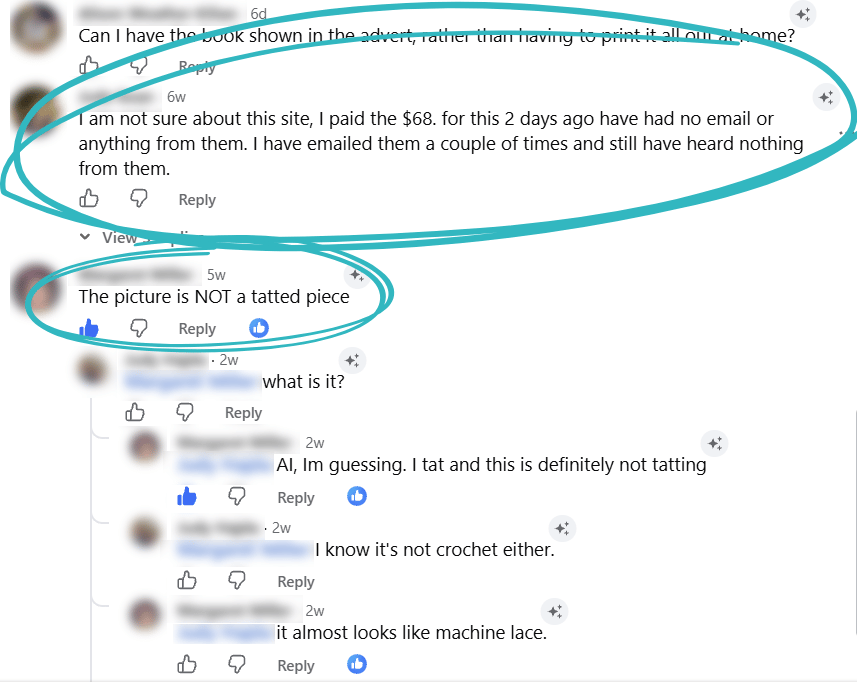
I’m not the only one with doubts. Under this page’s Facebook posts there are comments from tatters I’ve known in the online tatting community for years, whose work and knowledge I greatly respect. They, too, question how reliable these patterns and the site itself are. Another commenter writes that she paid and, two days later, had received neither the files nor a reply to her emails.
How to check patterns before you buy
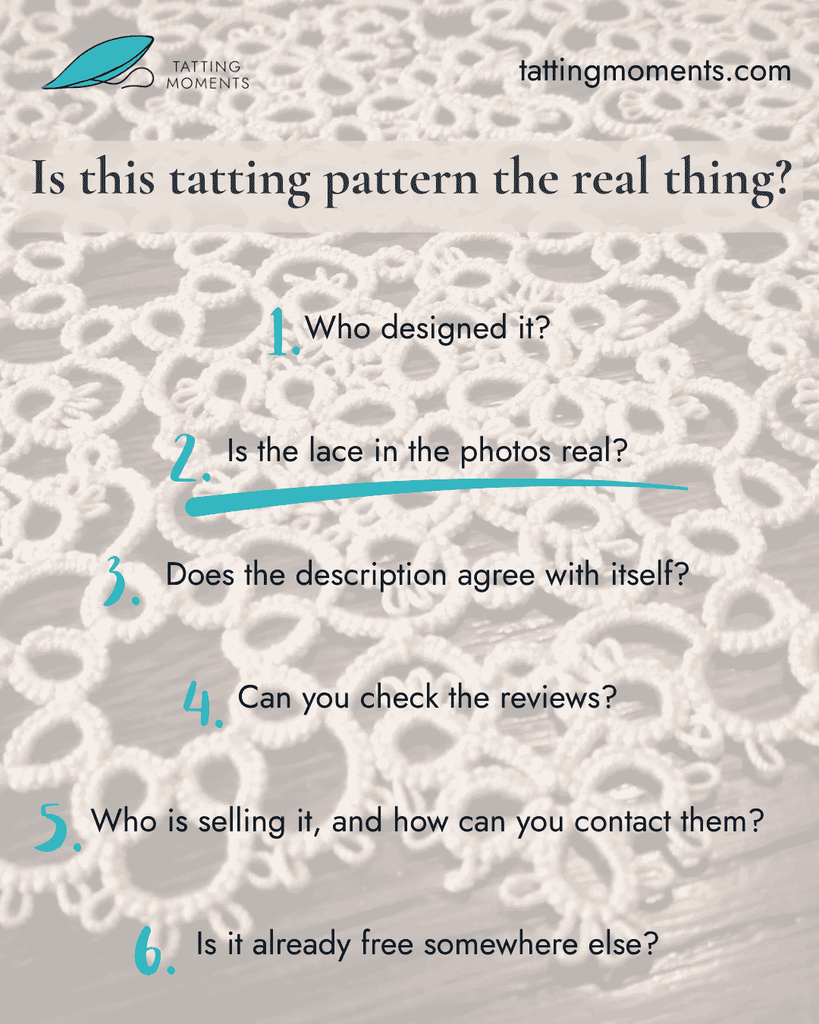
This site isn’t the only one, and it won’t be the last. Instead of learning to spot one site, it helps to have a few simple questions you can ask about any of them.
- Do you know who designed the patterns? A real designer has a name, a history and usually other work you can look at.
- Do the photos show real lace? Look for thread ends, small irregularities, photos from different angles. Perfectly smooth work in a perfectly styled scene is a warning sign.
- Does the description agree with itself? Number of patterns, licence, techniques. If the home page says one thing and the product description another, something’s wrong.
- Can the reviews be checked? Reviews with real photos of finished work are worth far more than comments with illustrations.
- Who’s selling, and how do you contact them? No business name and no address means that if something goes wrong, there’s no one to turn to.
- Is it available for free? Many classic patterns and books are in the public domain. Before you pay for a “vintage collection”, check whether it’s sitting in an open archive.
If an ad doesn’t pass these questions, you don’t have to assume bad intentions straight away. But you don’t have to pay to find out either.
If you’ve already bought
Check the files. If the product doesn’t match the description, contact the seller, and if that doesn’t help, raise it with your bank or payment provider. You can report the ad directly on Facebook. Misleading reviews and product claims can be reported to the ACCC in Australia, to Trading Standards through Citizens Advice in the UK, and to the FTC in the US.
Where to find patterns
I’m not writing this to put anyone off buying patterns. Tatting designers spend weeks on a single pattern. They tat it, adjust it, test it and draw the diagrams.. It’s worth buying from them, because then you know the pattern works.
A few places I recommend:
- LillianTatLace on Etsy: https://www.etsy.com/shop/LillianTatLace
- AlenAleaDesign on Etsy: https://www.etsy.com/shop/AlenAleaDesign
- Fairy Lace: https://fairylace.kozinenko.com/
- Renulek on Etsy: https://www.etsy.com/shop/Renulek
These are just a few. There are many more designers making carefully tested patterns.
You’ll find my own patterns at tattingmoments.com: https://tattingmoments.com/tatting-patterns/
Tatting is a craft where every stitch shows. Maybe that’s why it’s so easy to tell when someone has never made one.