
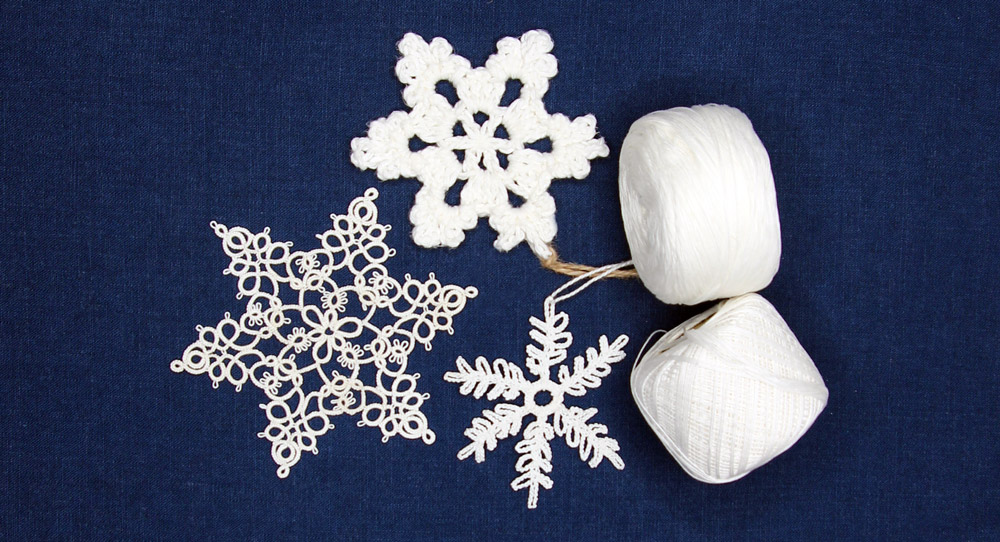
When it comes to tatting vs crochet difficulty, tatting immediately stands out. It is light, delicate, and very detailed, creating a strong WOW effect. Often even stronger than traditional crochet.
And yet, many people who feel comfortable with a crochet hook quickly discover that tatting feels more difficult.
Not because it is “only for experts”.
But because it works in a completely different way.
1. Technical differences in tatting vs crochet difficulty
The biggest difference between crochet and tatting lies in the foundation of the technique.
In crochet, we work with stitches. They are clearly visible, easy to count, and usually quite forgiving for beginners.
In tatting, everything is based on knots. These knots must form correctly and slide along the core thread. Understanding this movement is essential — and often confusing at the beginning.
If you want to see these differences explained side by side, you can read the article Tatting vs Crochet – 8 Key Differences, where both techniques are compared in more detail.
Another challenge is thread tension control. In tatting, every knot matters. If the tension is too tight or too loose, it affects the entire motif. Because of this, tatting naturally progresses more slowly than crochet — precision is more important than speed.
2. Mistakes are harder to fix
In crochet, a mistake usually means pulling out a few stitches and continuing the work. The fabric structure allows for easy corrections.
In tatting, things are different. Knots form a compact structure, and undoing work can be time-consuming and frustrating. Sometimes fixing one small error means undoing a larger section — or starting that element again from scratch.
3. The learning curve and visible progress
Crochet gives fast visual results. After just a few rows, you can already see the shape of your project, even if your technique is not perfect yet.
Tatting requires more patience. The first stages of learning are often focused on practicing knots, controlling thread tension, and memorizing hand movements. Decorative results come later.
That is why many people find tatting easier to learn with clear, step-by-step guidance — for example through a tatting course for absolute beginners, where the learning pace matches real beginner needs instead of ideal expectations.
4. Mental focus in tatting vs crochet difficulty
In tatting, counting is not optional — it is an essential part of the process at every stage. Each ring and each chain is made from a specific number of knots, and losing count immediately affects the shape and balance of the motif. Unlike crochet projects, where repeating stitch patterns often allow you to anticipate what comes next without counting every stitch, tatting requires constant attention to numbers. You need to count knots continuously, in every ring and every chain, from the beginning to the end of the project.
This need for precision means tatting demands more mental focus than crochet, even when the hand movements themselves are relatively simple. One small miscount can ripple through the design, so concentration is part of the craft — and part of what makes the finished piece so satisfying.
5. Access to learning and support
Crochet is widely popular. Classes, workshops, books, and tutorials are easy to find, both online and offline.
Tatting remains a niche craft. Finding an in-person teacher can be difficult, and many learning resources assume some prior knowledge. This means that tatting beginners often need to be more independent and intentional in choosing good learning materials.
That is why blogs and educational platforms dedicated specifically to tatting — such as Tatting Moments — play not only an inspirational role, but a truly educational one.
Tatting is harder than crochet — because it is based on knots instead of stitches, requires precise thread tension, a slower working pace, and greater concentration. It is a technique that does not reward rushing, but values patience and attention to detail.
In return, it offers something special: lightness, precision, and a visual impact that almost always creates a WOW effect.